


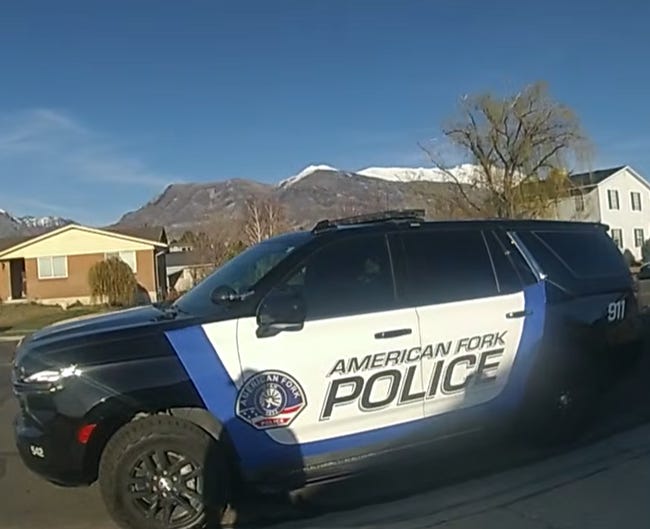
This article is a brief overview of eight controversial encounters involving the American Fork Police Department. For readers who want the full case-by-case breakdown, sources, links, and more detailed explanations, the longer article is available here: American Fork Police Department: Is There an Emerging Pattern of Constitutional Rights Violations?
The American Fork Police Department recently received public attention because of the Bricks & Minifigs controversy involving Ben Schneider, also known as Reckless Ben on YouTube. After that case became public, other controversial encounters involving American Fork officers also began receiving more attention.
After reviewing body-camera footage, news articles, lawsuits, public records, and legal commentary related to these eight encounters, I believe they reveal a troubling pattern of questionable police conduct, apparent constitutional violations, and disregard for due process.
The encounters show evidence of questionable traffic stops, warrantless entries into homes, arrests based on disputed probable cause, aggressive escalation, suppressed evidence, dismissed charges, lawsuits, and unprofessional police conduct.
This article summarizes those eight encounters and explains why I believe they deserve more public scrutiny.
The Eight Encounters
Ben Schneider — a civil LEGO dispute that escalated into a stalking investigation, traffic stop, and Airbnb raid.
Sheldon Norcross — an evidence-tampering arrest after he locked his phone while attempting to hand it to officers during the Airbnb raid.
Cody Greenland — police detained Greenland after a 911 call about someone breaking into cars, even though he was not the suspect. Body-camera footage shows him complying before he was tackled, searched, and arrested; the evidence was later suppressed and the charges were dismissed.
Joseph Ferreri — an aiding-prostitution charge based on his connection to his wife’s alleged conduct, even though the underlying charges were later dropped.
Eric Roundy — officers continuing to knock and demand contact at a home after residents declined to open the door or answer questions.
Janene Thorpe — an officer placed his foot in the doorway and entered a home without a warrant to issue a citation.
Aaron Booker — a questionable HOV stop that the officer later admitted was wrong, followed by a threat to break the window.
Michael Anthony Roy — a federal lawsuit alleging officers violently arrested the wrong man and failed to stop after the mistake should have been clear.
Pattern of Constitutional Concerns
The reason these cases are so disturbing is that they appear to show a repeated pattern of American Fork officers pushing the limits of constitutional rights, due process, and basic police accountability. Some of these encounters also involved the same officers, which makes the pattern harder to dismiss as isolated mistakes.
Across these cases, the recurring concerns include:
Warrantless entry into a home
Search-warrant applications with omitted or limited context
Arrests based on limited probable cause or lack of verification
Escalation during encounters where citizens asserted their rights
Questionable traffic stops
Use of force against compliant or mistaken individuals
Evidence later being suppressed
Criminal charges later being dropped
Lawsuits alleging civil-rights violations
Public apologies only after outside scrutiny
Why These Encounters Matter
These cases show a concerning pattern of questionable police conduct and apparent constitutional violations by American Fork Police officers. When you look at all these encounters together, they raise serious questions about the American Fork Police Department’s culture, training, supervision, and respect for constitutional limits.
The public should not have to wait for viral videos, lawsuits, dismissed charges, or suppressed evidence before asking whether a police department is operating responsibly. If there is a pattern of questionable stops, weak probable cause, warrantless entries into homes, escalation, and civil-rights litigation, then the public has a right to demand answers.
That is why I believe these cases deserve more public attention, more records requests, and more scrutiny from city officials, journalists, and ordinary citizens. Police accountability requires public involvement, and transparency is the first step.
I have been following this for quite a while and it is amazing I can tell you that the federal lawsuit depositions of the cops will be pay-per-view! It's amazing how stupid small town cops are about civil rights. They think no one is going to notice. This is the biggest thing since Afroman.